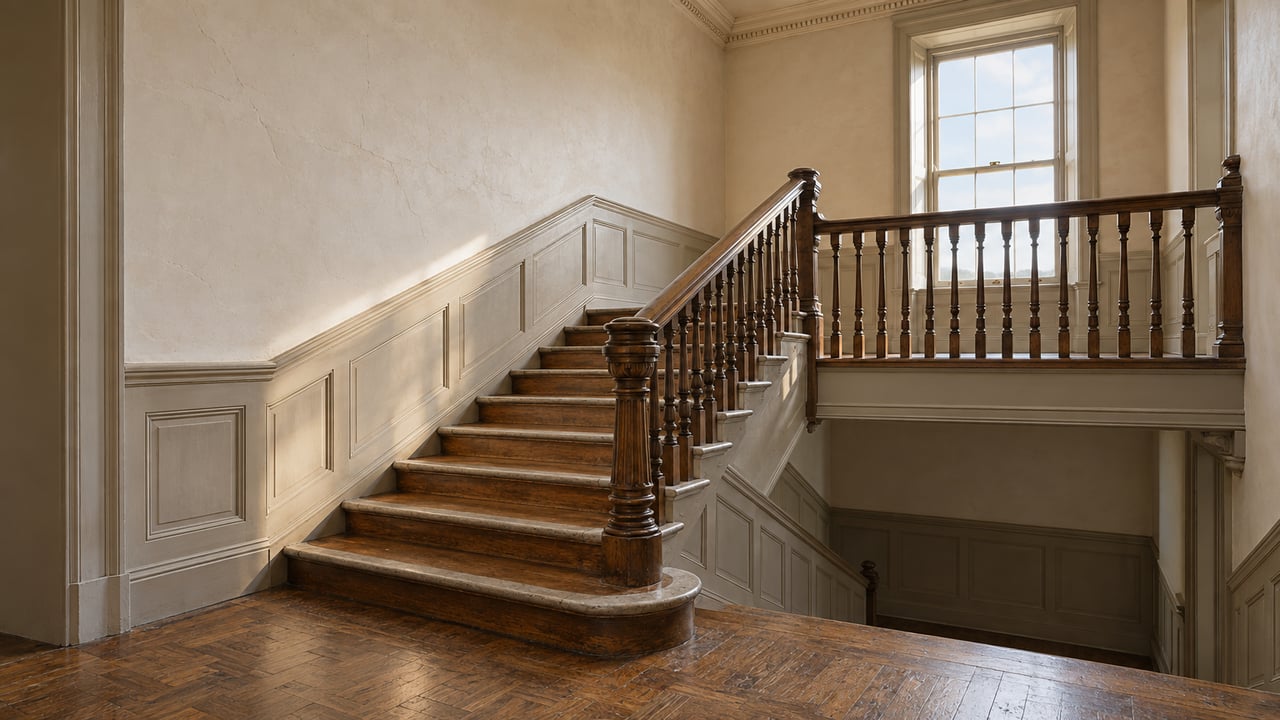
In its account of the restoration, the Brooklyn Eagle quoted Lara Birnback, executive director of the Brooklyn Heights Association: "We watched the near destruction and then resurrection of this special house." The report describes the building at the corner of Monroe Place and Clark Street that opens to the public on October 2. She's not exaggerating for effect. There's a photograph from May 2008 of this same house mid-demolition, walls open to the sky, and another from February 2023 of it wrapped in scaffolding and still not done. The 2008 photograph was taken eighteen years before the ribbon-cutting this fall.
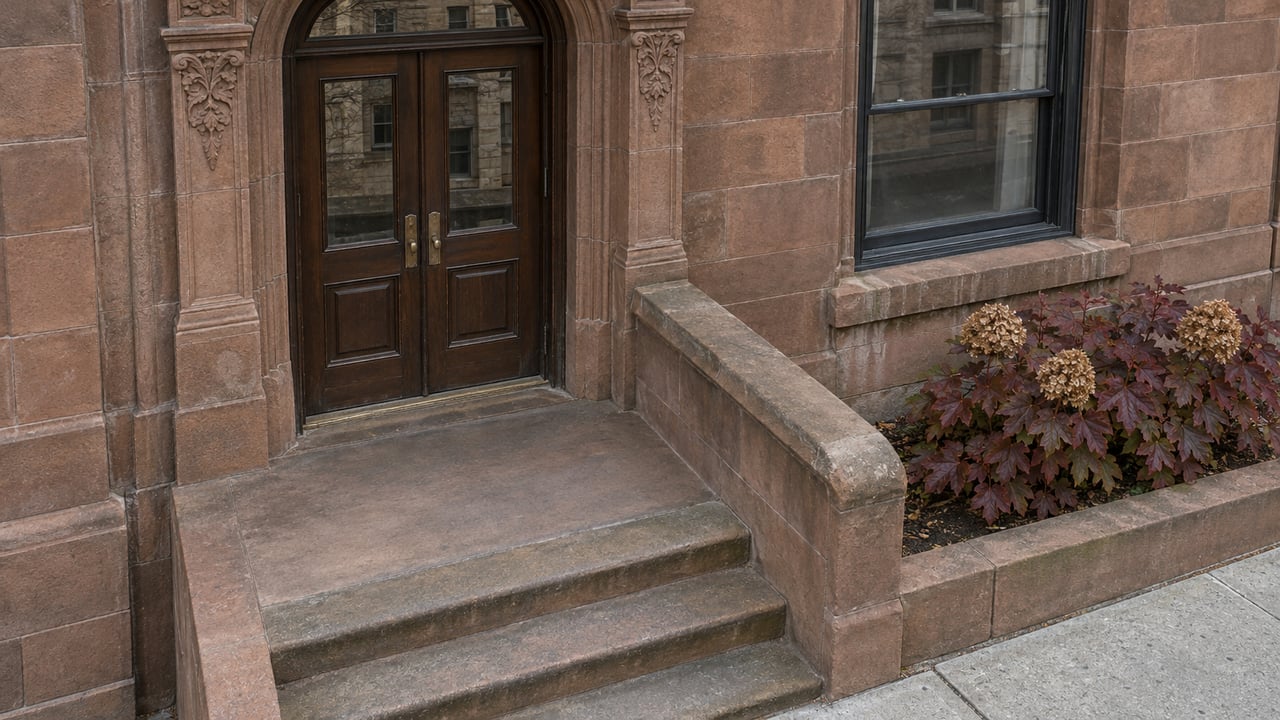
The house is called One Monroe Place, though the city's paperwork lists it as 100 Clark Street. It's a 25-foot-wide Greek Revival mansion built in 1852 for a New York merchant named Samuel Bell, in the center of what would eventually become Brooklyn Heights Historic District, the first historic district ever designated in New York City. In the 1860s someone added a fourth-story Mansard roof, the kind of detail that reads as pure 19th-century flourish today but was, at the time, just keeping up with fashion. By the 1890s the house belonged to the Weir family, whose floral business on Montague Street has been open continuously since 1853. It still is. If you've bought flowers on Montague Street in the last decade, you've patronized a business with a longer continuous run in this neighborhood than most of its buildings.
None of that history explains why the house nearly came down. That part is more ordinary and more instructive. By 1950, city Certificate of Occupancy records show the building had been carved into three apartments per floor, the kind of subdivision that happened to a lot of Brooklyn Heights mansions once single-family ownership stopped making financial sense. Subdivided buildings deferred maintenance for decades get expensive to save, and by 2008 this one had reached the point where demolition looked like the cheaper option. It came within a step of happening.
Why This Year's Canvas Is Different
What actually saved the house was a private buyer willing to sit on a restoration for the better part of ten years. Newcastle Realty Services, working with architect Tom van den Bout of NV/design.architecture, proposed a plan built from archival photos and drawings rather than a blank redesign. The Landmarks Preservation Commission approved it in August 2016, writing that the building's "style, scale, materials and details are among the features that contribute to the special architectural and historic character of the Brooklyn Heights Historic District" and that restoring it would return "a significant contributing building to the streetscape and to the historic district." The following year, the Brooklyn Historical Society hosted a public conversation between van den Bout and Newcastle president Margaret Streicker Porres about the archival method they were using, a level of public interest in a single house's renovation that tells you something about how this neighborhood watches its own buildings.
The Brooklyn Heights Designer Showhouse has existed since 2017, a biennial fundraiser for the Brooklyn Heights Association founded by Ellen Hamilton and Erika Belsey Worth. Every previous edition has used a rowhouse or townhouse: an 1860s townhouse on Livingston Street for the inaugural year, a wood-frame house in 2019, and in 2024 a house on Clinton Street known locally as part of "Doctor's Row," a stretch of homes once occupied by a string of medical practitioners and later the site where Bill and Lois Wilson founded Alcoholics Anonymous in 1934.
This year breaks that pattern. One Monroe Place is a freestanding corner mansion, not a rowhouse, and at 9,525 square feet with nine bedrooms, seven bathrooms, a rooftop terrace, and six floors of interior space, it's a meaningfully bigger and more varied canvas than anything the Showhouse has worked with before. Organizers are calling it the program's most ambitious assignment to date, and the math backs that up: five editions in, this is the first time the public gets to walk through an entire standalone house rather than the narrow, stacked rooms of a typical Brooklyn Heights rowhouse. If you've toured past Showhouses and found yourself squeezing past other visitors in a hallway, this year's floor plan should feel different.
Who's Actually in the Rooms
The Association's initial announcement in August named seventeen participating firms. By the time tickets went on sale, the event's own listing had grown that to nineteen, which suggests a couple of names joined after the first press release went out. Either way, the roster mixes Brooklyn regulars with out-of-town talent. Brian Cash Works, the New York and Atlanta studio founded by Yale-trained architect Brian Cash, is on the list, as is Stollar Fearins Welch, a Manhattan firm known for a "livable luxury" style that blends Brooklyn and Southern sensibilities. Hannah Hemmerly of HH Studio brings an art-history background to narrative-driven rooms. Max Aboody Interiors, based in Dumbo and led by a Parsons-trained designer, is there too, along with Llewellyn Chupin, whose practice splits time between New York and Paris, and Studio Olivine, run by art historian Hannah Blumenthal.
The sponsor list is long enough to double as a who's-who of the design trade right now: Farrow & Ball and Silverlining as the top-tier Gold Sponsors, with California Closets, Drummonds, Janus et Cie, Momeni, Remains Lighting Company, and Wovn Home listed as Patrons. Schumacher, Kravet, HunterDouglas, and Doyle Auctioneers & Appraisers round out the supporting sponsors. Sarah Boyd of Sarah Boyd Co. is producing the event.
The Practical Part
If you want to see it yourself, here are the event details, including the public hours still ahead:
- Opening Night Party: Wednesday, September 30, 6:30 to 9pm. This was the ticketed fundraiser evening, with a full house tour, time with the designers, and cocktails.
- Public visiting hours: October 2 through November 1. Thursday and Friday, 11am to 7pm. Saturday and Sunday, 10am to 6pm.
- Group tours: Private group visits can be booked separately from general admission.
All proceeds go to the Brooklyn Heights Association, which is worth understanding on its own terms and not just as the group throwing the party. Founded in 1910, the BHA is New York City's oldest neighborhood civic association, and it was instrumental in getting Brooklyn Heights designated as that first historic district in the first place, back when there was no guarantee a mansion like this one would still be standing eighty years later for anyone to almost lose and then save. The same organization pushed for the Brooklyn Heights Promenade and helped preserve the waterfront that eventually became Brooklyn Bridge Park. The Showhouse ticket you buy this fall is funding the same civic muscle that got exercised, slowly and expensively, to keep One Monroe Place from becoming a parking lot.
That's the part of this story worth sitting with longer than the room reveals. A neighborhood can talk about preservation in the abstract, or it can point to a specific corner where a house was mid-demolition in 2008 and is now hosting nineteen designers and preparing to welcome visitors in 2026. Brooklyn Heights has that second kind of proof, standing at Monroe Place and Clark Street, soon to be open for anyone who wants to walk through it before November 1.
If you're weighing what a house like this one, or any Brooklyn Heights property with real bones and a complicated past, is actually worth taking on, The Rosen Team has spent years reading buildings exactly like it. Schedule a 10-minute introductory call and bring your questions about what you saw on the tour.